Northwood Blog
BackMilestone 9: Seven days from flat ground to connecting with a government satellite in GEO
“Northwood, we have good data.”
On September 17, the operations team for a U.S. Government satellite sent us that message. Seven days earlier, the antennas behind it had not yet left our facility.
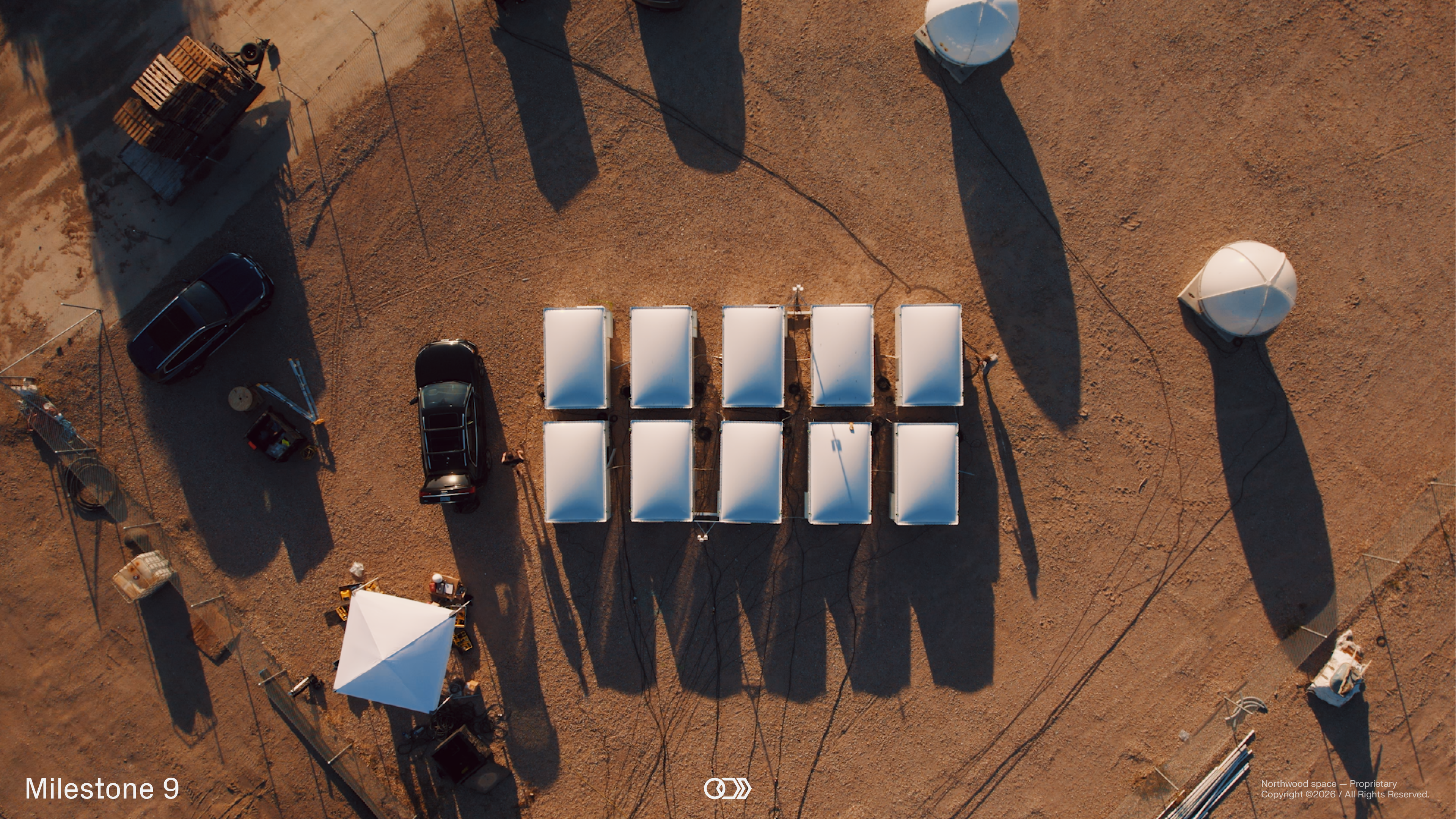
Ten of our refrigerator-sized Portal arrays combined to hear a spacecraft in geosynchronous orbit (GEO), and one of them sent commands back. Together they closed a full-duplex link and held it for an hour, delivering the receive gain and transmit power (EIRP) of the large parabolic dishes used to reach GEO today.
Here’s what that means for the space industry: adding ground capacitydoesn’t have to take years; we did it in a week.
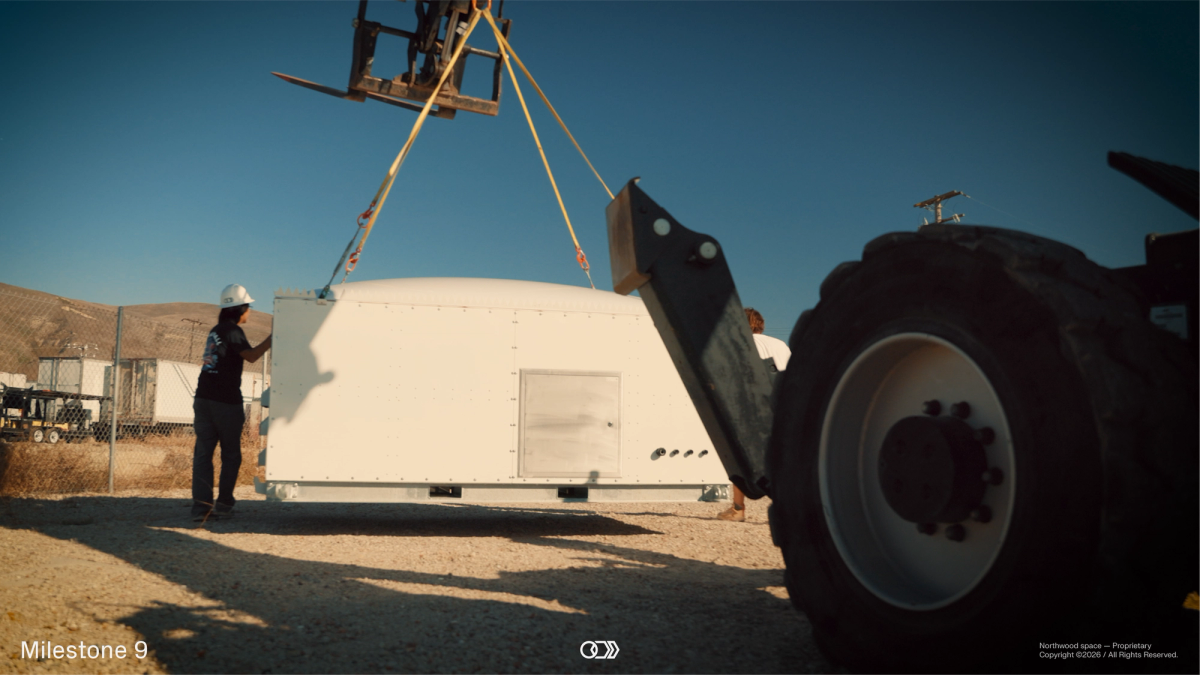
We engineered Portal for hard problems like this one, and we designed the hardware to be fast to manufacture and deploy. The arrays that reached Ventura were standard units, so the week in September went to setup, calibration, and integrating with our partner rather than custom construction.
Missions wait on the ground
Most space operators have “planned around” ground connectivity at some point. It rarely shows up in a requirement document, but our customers describe the same workarounds we’ve felt in government and commercial missions: narrowing a mission profile because no antenna was in view, holding operations while a site came together, or budgeting years and millions of dollars for ground capacity before the first contact.
The workarounds have become so normal that they are shaping our expectations of what is possible in space.
The need for connectivity is large -- and growing. There are more satellites in more orbits, while the ground has not kept pace. Demand for satellite-to-Earth contact capacity is expected to skyrocket over the next decade. The U.S. Space Force estimates national security contact demand alone could rise as much as 400%. To maneuver in space and talk to the ground, every one of those contacts needs a ground antenna that is available, in view of the satellite, and able to talk to it.
For nine months, under a prototype contract with Space Systems Command’s Portfolio Acquisition Executive for Battle Management Command, Control, Communications and Space Intelligence (BMC3I), we set out to prove that Portal could deliver assured telemetry, tracking, and command (TT&C) under the most demanding conditions.
Earlier tests proved full-duplex communications with satellites in LEO. But the last milestone was the hardest: send commands up from a Northwood ground station and receive telemetry back from a government satellite in GEO, with the contact booked through the Joint Antenna Marketplace, the Space Force’s new system for bringing commercial ground capacity to government missions.
GEO tests the extremes of distance and power. By the time a GEO satellite’s signal reaches the ground, it’s about ten billion billion times weaker than when it left. But the signal going up must be strong enough to survive the same trip. So, the ground station connecting with the satellite needs to do two hard things at once: hear a near-whisper and answer loudly enough to be heard.
Two routes to GEO
Until now, there were two ways to reach GEO, and each one takes time.
Large parabolic dishes. A dish has to be big to reach a satellite that far away. The reflector needs to be 20 to 40 feet (6 to 12 meters) across, about a two-story house if stood on its side, to get the gain and narrow beam the link requires. And that size drives everything else. Each 12-meter dish carries about 15,000pounds of wind load in 60 mph winds, so a site needs on-site engineering, and a deep foundation of140,000 pounds of concrete. And while powerful, each dish is mechanically steered, so it follows one satellite at a time. Every additional satellite means another dish, spaced far from its neighbors so they don’t block each other at low elevation angles. That makes a site for proliferated space quite large: to track 10 satellites from a site, you’d need 10 dishes, and each dish requires 300 to 1,000 square meters. That puts a multi-beamed site at roughly 6-7football fields.
Custom GEO phased arrays. Electronically steered phased arrays change what a site needs, but not the physics. One array can serve many satellites at once by using software to instantly form and split multiple beams, essentially reusing the same aperture continuously. But closing a link across 36,000 kilometers still takes a large aperture and serious power. Amplifiers for each antenna element, packed that tightly, create intense heat that must be dissipated. The array face still needs to be quite large to receive transmissions. And transmitting while receiving requires extreme filtering or separate transmit and receive panels. Arrays of that size and performance need complex manufacturing and long-lead custom parts, which means higher cost and longer deployment. And they still require a larger footprint than the typical Northwood site of roughly one-third of a football field.
So operators have had to pick: the proven performance of a dish, with months to years of construction, or the flexibility of a phased array, with custom hardware and long lead times. Portal is built so they don’t have to.
How Portal closed the link
Here’s how our Portal reaches GEO and can serve satellites across multiple orbits, in a footprint no larger than a single dish:
Hearing the whisper: ten arrays acting as one. A single Portal array does not have enough gain to close a GEO receive link on its own. So we coherently combined ten of them, making the group behave like one larger aperture. That is big-antenna performance from small, deployable arrays.
Answering loudly: one array with GEO-level power. We transmitted from a single Portal array. From the start, we designed and innovated unique technical aspects of the array for GEO-level power, so one array could supply the EIRP (the effective power the satellite sees), and the bandwidth needed to hold a duplex link. We solved for the typical problems that slow custom arrays inside one standard unit.
Adapting live: software-defined networking. Portal’s beamforming, pointing, and radio settings are all controlled in software. When terrestrial interference disrupted signal tracking, our team reacted live and kept the link up.
Neither receive nor transmit needed a custom part or a one-off design, and both ran on the same Portal arrays we build for every site. That is how Portal avoids the trade-off: dish-class performance without dish-class construction and phased-array flexibility without custom hardware.
Milestone 9: seven days, from our facility to GEO
Our final test was planned for another site on another continent. On September 3, that site fell through. On September 10, we learned a test satellite would be in view of California and available for testing for only a few days. So we pivoted:
- Sept 10. The first Portal arrays leave our facility.
- Sept 11. Ten arrays are on site in Ventura, powered and online.
- Sept 12. First downlink, 48 hours after the first array shipped.
- Sept 12-14. We calibrate using the sun and validate on live passes of JASON-3, a public ocean-monitoring satellite.
- Sept 15. Northwood, the Joint Antenna Marketplace team, and the mission partner onboard the Ventura site and the satellite’s configuration into the Space Force’s scheduling system, in a matter of hours.
- Sept 16. We receive 15 minutes of clean downlink from the GEO satellite, with zero uncorrectable frames.
- Sept 17. Full duplex connection to GEO, commands up and telemetry down.
How every Northwood site comes online
We didn’t plan to run our final test from Ventura, but an opportunity materialized for us to flex and show off the capability and flexibility of what we built. It wasn’t a special deployment, however. It is the same process we’re using to build out the Northwood network: standardized, modular antennas, designed and built at rate in Torrance, shipped by commercial methods on integrated bases. They arrive at sites factory-calibrated and need only flat ground, power, and a network connection. That is why the week was possible. The hard engineering went into the design, and the hardware is built to be manufactured at volume and deployed quickly.
We’re on two continents today, with more coming online. Operators can reserve dedicated capacity or use shared capacity across the network, and operators who want their own sites can buy the same hardware.
Ground capacity has been measured in years. In Ventura, we measured it in days.
Government mission owners: if your mission is waiting on ground, let’s talk about dedicated capacity: contact@northwoodspace.io
Commercial operators: if you need TT&C across orbits, let’s talk about getting you on the network contact@northwoodspace.io