Northwood Blog
BackIntroducing our high-throughput infrastructure for modern space missions
Data infrastructure for space was built for a different problem set. For most of the history of human spaceflight, the space side wasn't demanding much for its rather niche use cases. Traffic was periodic, with bursty downlinks from a handful of satellites and spacecraft to a single dish. A narrow straw worked well for the volumes of that era: a remote fire crew in the mountains needing emergency services, a vessel at sea pinging with its location, a short mission in a contested environment. The infrastructure was fit for purpose because the purpose was bounded.
But our purpose in space is no longer bounded. Satellite constellations are proliferating across LEO, MEO, and GEO.
Payloads are now doing things that weren't viable five years ago: monitoring agricultural yields and maritime traffic across entire ocean basins in real time, connecting autonomous fleets and remote infrastructure that terrestrial networks don't reach. And in the near future they may be running AI inference in orbital data centers and routing results to Earth fast enough to close a real-time decision loop. The data those missions produce is measured in petabytes. The infrastructure receiving it was built for megabytes.
Today, we’re announcing an expansion of our network to handle the most demanding things spacecraft need to do today: moving massive amounts of data, serving compute running in orbit, connecting millions of devices. Today, our network is deployed, and:
- We are already operating five sites across two continents
- By the end of this year, we’ll have global coverage capable of at least 10 Gbps per site across over a dozen sites
- By the end of 2027, we will more than double our link capacity and site footprint with 100+ Gbps-capable sites in high-demand regions, and
- By 2028, we’ll have enough capacity deployed to rival the aggregate capacity of a terrestrial internet peering exchange
We’re building the internet for space
There’s a logic that governs space economics: once a satellite is in orbit, the capital is sunk and depreciating whether or not it's doing anything. The only way to earn a return on it is to keep it busy, which means keeping data moving through it continuously. Utilization — satellite time actually filled with payload versus capacity sitting idle — is therefore the single variable that determines whether the investment pays off.
And the same logic translates to ground networks: when link reliability is uncertain, operators overbuild to hedge against downtime, and idle backup capacity still depreciates. When ground infrastructure is bespoke and purpose-built for individual missions, it can't be applied to other missions when those contact windows close. The result is capital that sits dark more than it is used, and the cost per gigabit that reflects that waste.
Northwood's network inverts this: technology matched to each mission's requirements, shared across customers through a common software layer rather than infrastructure each must build independently.
Northwood's network delivers what existing infrastructure was not designed to provide: data that lands in the right place, throughput matched to what next-generation payloads actually produce, and contacts reliable enough for commercial operators to write SLAs around.
Introducing Prism
Northwood's antenna family now spans two complementary architectures. Portal is our modular phased array system, built for the future of space mobility. It uses precise, high-power command links to dynamically maneuver spacecraft that require coordination and sensing so they can safely and continuously operate.
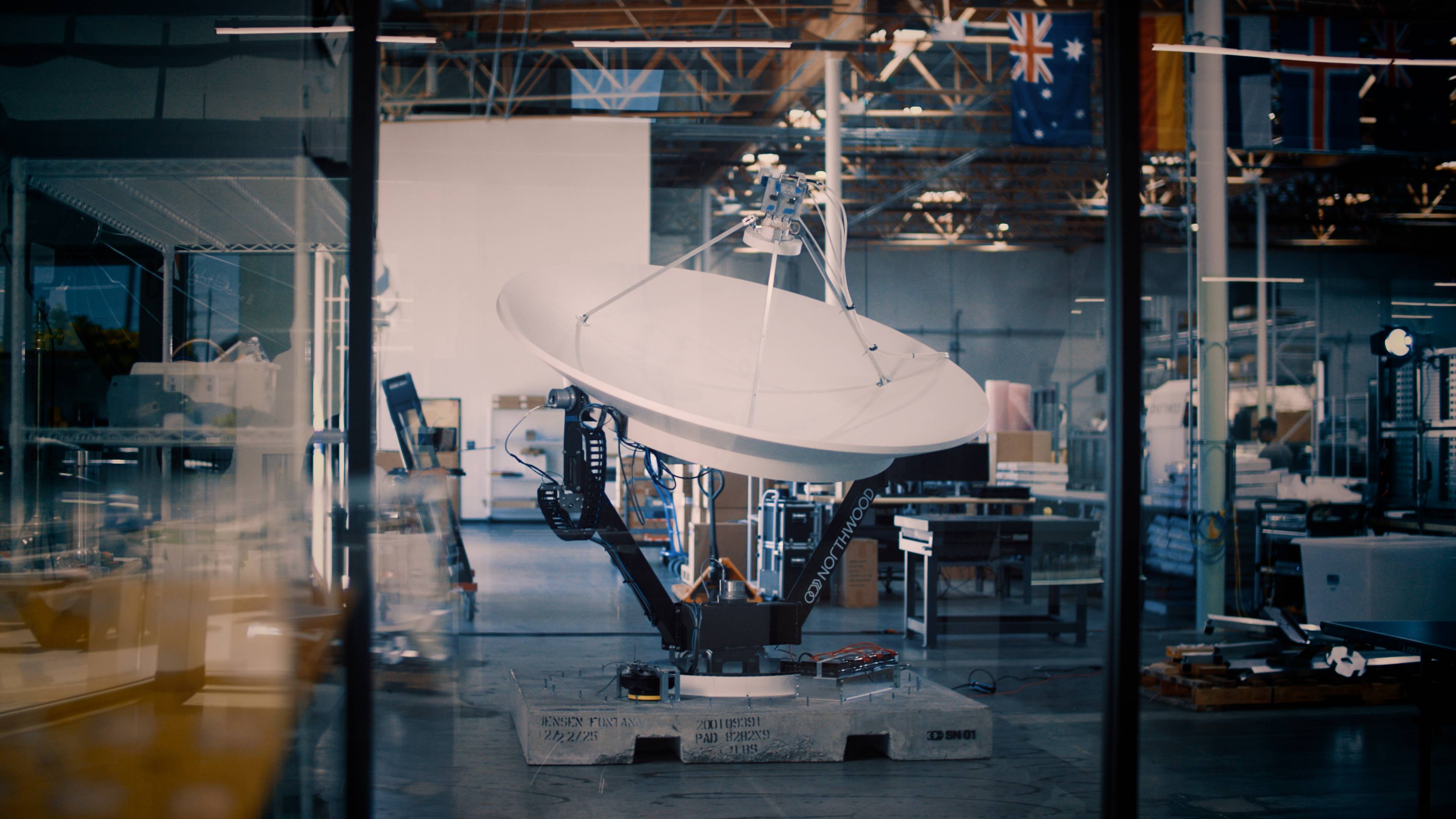
Prism is built for high-volume data delivery. The system uses a novel technique originally developed for Northwood’s Portal antenna, developed to combine antenna units and reach the power levels required for high-throughput links in any orbit, in virtually any environment or atmospheric condition. The form factor is standardized, which means it can be manufactured and deployed rapidly. Together, those two things are how Northwood scales high throughput capacity: a design powerful and resilient enough for modern space missions, built to be fielded quickly.
Both are manufactured at Northwood’s 35,000 sq ft facility in Torrance, running firmware and software built in-house. That vertical integration lets us iterate on RF and software in lockstep rather than waiting on a vendor when something needs to change in the field. A new site goes from delivery to operational in under 24 hours.
Northwood's software platform schedules contacts, routes traffic, monitors assets, and coordinates antennas across the network, turning a collection of individual antennas into a unified space networking architecture. It handles mission prioritization, link optimization, and policy-based routing based on spectrum permissions, site availability, and customer requirements.
What we will do
By 2028, Northwood is on a trajectory towards operating a network with aggregate throughput capacity equal to the world's internet exchanges (over 20 Tbps), and will continue to keep scaling. This is capacity comparable to the largest terrestrial internet exchange points, the physical hubs where the world’s networks meet to hand off traffic. Those exchanges took decades to build. Northwood is building the space equivalent from scratch, in years.
If you’re interested in building with us, check out our open roles.